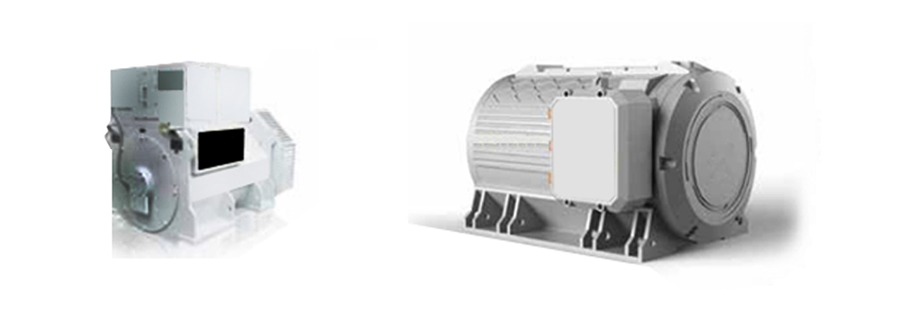

The propulsion motor is the core component converting electrical energy into ship navigation kinetic energy, whose performance directly determines the ship’s speed, thrust, response sensitivity and energy efficiency, requiring full adaptation to lithium battery systems’ power supply features and ships’ diverse navigation needs.
In terms of technology selection, mainstream propulsion motors are mainly permanent magnet synchronous motors (PMSM). Compared with traditional asynchronous motors, PMSM has advantages like higher power density (20%-30% more output power under the same volume), wider efficiency range (over 95% at rated conditions and over 90% at some light-load conditions), and excellent low-speed, high-torque performance. It can match ships’ thrust needs from low-speed cruising to high-speed navigation, reduce lithium battery consumption and extend range. Some small ships or special operation vessels (e.g., harbor tugboats) also use brushless DC motors (BLDC) to balance cost and maneuverability.
For structural design, propulsion motors need scenario-specific optimization:
In control logic, propulsion motors must coordinate closely with motor controllers (inverters) and ship energy management systems (EMS): controllers receive speed/thrust commands from the bridge, adjust stator current amplitude/phase via vector control based on lithium batteries’ real-time voltage/current to smoothly control speed and torque, avoiding current surge impacts on batteries. Meanwhile, they collect real-time data (stator temperature, rotor speed, torque, insulation resistance) and feed it back to the cabin console. When abnormalities (overcurrent, overheating, insulation failure) occur, they can quickly cut power or reduce load to ensure safety.
Additionally, propulsion motors have fast response (0.5-2 seconds from acceleration command to target speed), meeting rapid power adjustment needs for berthing or emergency avoidance. Some high-end models support energy recovery, switching to generator mode during deceleration/reversal to convert propeller mechanical energy into electricity for battery recharging, further improving energy efficiency and aligning with all-electric ships’ green positioning.